

NEET Time Management Strategies 2026: The 6-Month Master Plan
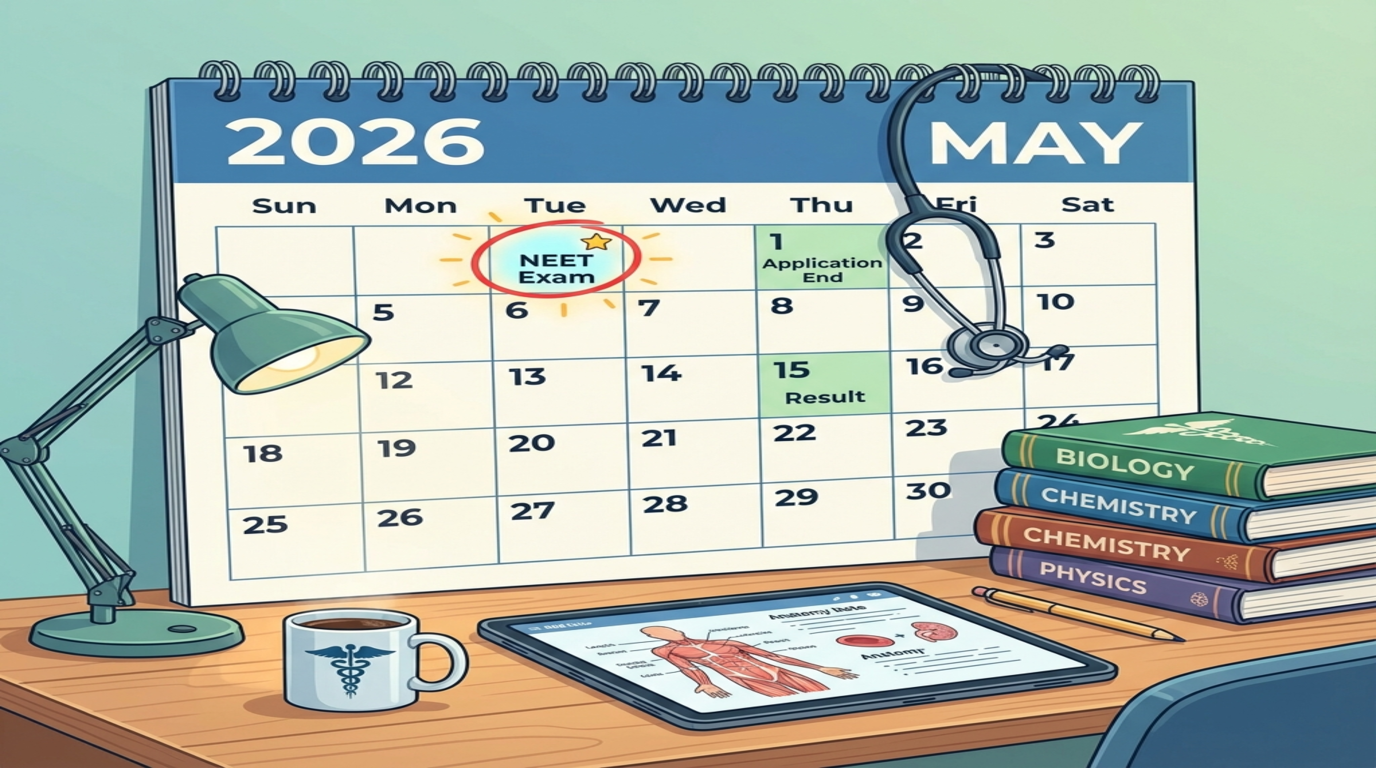
As of November 2025, the countdown to NEET 2026 has officially entered its most critical phase. With the exam tentatively expected in May 2026, you have approximately 6 months left.
This isn't just "time remaining"; it's the "make or break" window. Whether you are a Class 12 student juggling board exams or a dropper fully focused on NEET, how you manage these next 180 days will define your rank.
The NEET exam pattern has evolved to be a test of speed, accuracy, and endurance. You have 180 minutes to solve 180 compulsory questions. There is no room for error, and definitely no room for wasted time.
This comprehensive guide is your roadmap for the next 6 months, designed to transform you from a student into a rank-holder. We will cover everything from monthly timelines to daily schedules, subject-wise strategies, and the psychological aspects of preparation.
The "Reverse Engineering" Timeline: From Now to May 2026
To achieve a big goal, you must break it down into manageable chunks. Let's reverse-engineer your success starting from the exam date and working backward to today.
Phase 1: Foundation & Completion (November 2025 - January 2026)
Goal: Finish 100% of the syllabus. No new topics should be left for after January.
- November: Focus on high-weightage chapters in Physics (Mechanics) and Chemistry (Organic). Ensure your Class 11 backlog is cleared.
- December: Complete the remaining syllabus. Start integrating full-syllabus revision of Class 11 topics alongside Class 12 studies.
- January: Final lap for syllabus completion. This is the time to touch upon "low yield but easy" topics like Environmental Chemistry or Polymers.
- The "Buffer Day" Concept: Schedule one day every two weeks as a "Buffer Day". Use this day solely to catch up on any missed targets from the previous weeks. This prevents backlog from piling up.
Phase 2: The Mock Test Marathon (February 2026 - March 2026)
Goal: Shift from "Learning" to "Testing".
- February: Start taking full-length mock tests every Sunday. Analyze them rigorously.
- March: Increase frequency to 2 tests per week.
- Board Exam Balance: If you are in Class 12, use this time to strengthen 12th syllabus topics which overlap with NEET. Treat your Board Exams as a detailed revision of the Class 12 NEET syllabus.
Phase 3: The Final Sprint (April 2026)
Goal: Peak Performance.
- Action: Daily Mock Tests (2:00 PM - 5:20 PM). Train your biological clock to be most active during exam hours.
- Focus: Error analysis. Fix the small leaks in your knowledge.
- Health: Sleep well. Your brain needs to be sharp.
Subject-Wise Time Allocation Strategy
Not all subjects are created equal, and your time allocation shouldn't be equal either.
Physics: The Rank Decider
Physics is often the nightmare for medical aspirants, but it is also the subject that differentiates a top ranker from an average one.
- Time Allocation: 30% Theory, 70% Practice.
- Strategy: Don't just read formulas. Apply them. For every hour of theory, spend 2 hours solving numericals.
- High-Yield Topics: Mechanics, Electrodynamics, Optics, and Modern Physics.
Chemistry: The Scoring Subject
Chemistry offers the best return on investment (ROI) for your time.
- Physical Chemistry: Treat it like Physics. Focus on formulas and numericals.
- Organic Chemistry: It's all about mechanisms. Don't rote learn reactions; understand why electrons move the way they do.
- Inorganic Chemistry: NCERT is your Bible. Read it line by line. Make short notes of exceptions and trends.
Biology: The Backbone
Biology constitutes 50% of the paper (360 marks). You cannot afford to lose marks here.
- Time Allocation: 100% NCERT.
- Active Recall: Don't just passively read. Close the book and try to recite the paragraph you just read.
- Diagrams: Pay attention to labeling in diagrams. Questions are often framed directly from them.
Daily Schedules: The "Ideal" Day
A schedule is only good if you can stick to it. Here are two realistic schedules based on your student status.
Scenario A: The School Student (Class 12)
You have limited time due to school. You need to be hyper-efficient.
| Time | Activity |
|---|---|
| 5:30 AM - 7:00 AM | Physics/Chemistry (High Focus): Tackle the hardest topic while your mind is fresh. |
| 7:00 AM - 2:00 PM | School: Try to solve MCQs during free periods. Pay attention in classes relevant to NEET. |
| 3:00 PM - 5:00 PM | Coaching / Self Study: Focus on Class 12 topics. |
| 6:00 PM - 8:00 PM | Class 11 Revision: Dedicate 2 hours daily to keep Class 11 topics alive. |
| 8:30 PM - 10:00 PM | Biology NCERT: Lighter reading before bed. |
| 10:00 PM | Sleep: Essential for memory consolidation. |
Scenario B: The Repeater
You have the luxury of time, but the curse of procrastination. Structure is your best friend.
| Time | Activity |
|---|---|
| 6:00 AM - 9:00 AM | Slot 1 (Physics): Deep work session. Theory + 50 MCQs. |
| 9:00 AM - 10:00 AM | Breakfast & Break. |
| 10:00 AM - 1:00 PM | Slot 2 (Chemistry): Organic/Physical. Theory + 50 MCQs. |
| 1:00 PM - 2:00 PM | Lunch & Power Nap (20 mins). |
| 2:00 PM - 5:00 PM | Slot 3 (Mock Test / Practice): Simulate exam conditions. Sit at a desk, no phone. |
| 5:30 PM - 7:30 PM | Analysis: Review the mistakes made in Slot 3. |
| 8:30 PM - 10:00 PM | Slot 4 (Biology): NCERT reading. |
The Art of Mock Test Analysis
Taking a mock test is only half the job. The real learning happens in the analysis. Use the 3-Column Method:
- Silly Mistakes: Calculation errors, reading the question wrong.
- Fix: Practice mindfulness. Read the question twice.
- Conceptual Errors: You thought you knew it, but you applied the wrong concept.
- Fix: Go back to the textbook/notes. Re-learn the concept immediately.
- Time Gaps: You knew the answer but it took too long.
- Fix: Practice more questions of this type to build speed.
The "Revision Loop": Spaced Repetition
The human brain is designed to forget. To counter this, use Spaced Repetition.
- Day 1: Study Topic A.
- Day 3: Revise Topic A (15 mins).
- Day 7: Revise Topic A (10 mins).
- Day 30: Revise Topic A (5 mins).
Short Notes: Create condensed notes (1 chapter = 1 page). These will be lifesavers in the final week before the exam.
Avoiding Burnout: The Marathon Mindset
NEET preparation is a marathon, not a sprint. If you run too fast in the beginning, you will collapse before the finish line.
- Pomodoro Technique: Study for 50 minutes, take a 10-minute break. This keeps your concentration high.
- Sleep: Never compromise on 6-7 hours of sleep. Sleep is when your brain moves information from short-term to long-term memory.
- Nutrition: Eat light, healthy food. Heavy meals make you lethargic.
The Exam Hall Strategy: 180 Minutes of Focus
On the D-Day in May 2026, you will face the ultimate time management challenge. Here is the strategy used by toppers.
1. The "Biology First" Rule
Biology constitutes 50% of your marks (360/720).
- Target: Solve 90 questions in 45-50 minutes.
- Why: It builds massive confidence early in the exam. You secure half the paper in the first hour.
2. Chemistry: The Bridge
- Target: Solve 45 questions in 45-50 minutes.
- Strategy:
- Inorganic: Do it fast (like Biology).
- Organic: Visualize mechanisms.
- Physical: Save calculations for the end of this section.
3. Physics: The Decider
- Target: Solve 45 questions in 60-70 minutes.
- Strategy: You have saved time from Bio and Chem. Now use it here.
- Selection: Don't get stuck on one hard question. If a calculation takes > 2 mins, skip it and come back.
4. The OMR Strategy
- Don't fill OMR at the very end. It's too risky.
- Do fill OMR after completing each subject section. It gives your brain a 30-second "micro-break" to reset before the next subject.
Common Pitfalls to Avoid in 2026 Preparation
- Ignoring Class 11 Syllabus: Many students focus only on Class 12. Remember, Class 11 carries ~40-50% weightage. Revise it now (Nov-Dec).
- Multiple Reference Books: Stick to one good coaching material and NCERT. 10 books read once is useless; 1 book read 10 times is gold.
- Social Media Distraction: You have 6 months. Delete the apps. The reels can wait; your career cannot.
Frequently Asked Questions (FAQs)
Q: Is 6 months enough to crack NEET 2026? A: Yes, absolutely. If you are focused and consistent, 6 months is sufficient to cover the syllabus and practice enough mock tests to secure a good rank.
Q: How many hours should I sleep during NEET preparation? A: Aim for 6-7 hours. Sleep deprivation leads to poor memory retention and increased anxiety.
Q: Should I skip school to study for NEET? A: If your school attendance policy allows, you can take some days off for self-study. However, ensure you are actually studying during that time and not wasting it.
Conclusion
NEET 2026 is not far away. Six months might seem like a lot, but it flies when you have a mountain of syllabus to cover.
Every hour you waste now is a rank slipping away. But every hour you invest is a step closer to your dream medical college.
Start today. Plan your timeline. Stick to the schedule. And remember, the clock is ticking, but you are the pilot.
Aiming for a top rank in NEET 2026? Aims Academy's "Final Lap" crash course and test series are designed to optimize your last 6 months. Join us and make every minute count.
Get the latest NEET preparation tips and study strategies delivered to your inbox.
No spam. Unsubscribe anytime.